4.6 out of 5 stars
(608 Ratings)
Retool is a modern AI-native application development platform designed to help teams build internal software quickly and efficiently. It enables users to create agents, workflows, dashboards, and full-stack apps using natural language prompts and visual tools. Retool connects directly to databases, APIs, vector stores, and AI models to ensure applications work seamlessly with existing systems. The platform allows teams to transform raw data into actionable tools such as dashboards, admin panels, and monitoring systems. With drag-and-drop UI building, code-level customization, and AI-assisted generation, Retool supports multiple development styles. Built-in workflows automate complex processes while maintaining auditability and security. Retool fits naturally into standard engineering stacks with support for CI/CD and version control. Enterprise-grade permissions and hosting options ensure sensitive data stays protected. Used by thousands of companies worldwide, Retool helps teams ship AI-powered software faster. It bridges the gap between idea and production with speed and control.
Learn more about Retool
5.0 out of 5 stars
(3 Ratings)
BAND creates robust interaction frameworks designed for enterprise-level applications of distributed AI agents. The platform facilitates immediate, collaborative interactions among both agents and humans, incorporating a runtime control plane that upholds policies, defines authority limits, and ensures transparency across diverse systems.
Additionally, BAND empowers developers, engineering teams, and leaders of enterprise platforms who are managing multi-agent ecosystems spanning internal infrastructures, SaaS solutions, and environments shared with partners. This support enhances operational efficiency and fosters innovation within complex organizational structures.
Learn more about BAND
MetaGPT
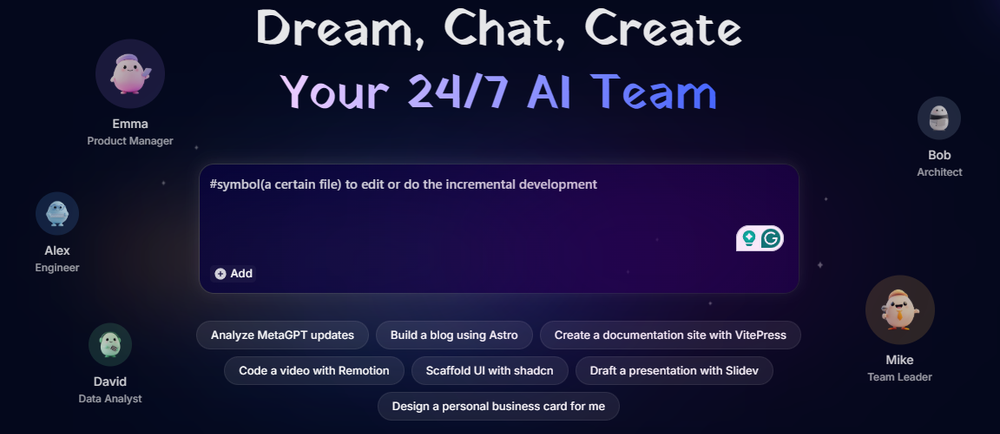
The Multi-Agent Framework allows for the transformation of a single line requirement into a comprehensive set of outputs including PRD, design specifications, tasks, and repository details. By assigning various roles to separate GPTs, a synergistic software entity is created that can tackle intricate projects effectively. MetaGPT processes a one-line requirement to generate user stories, competitive analyses, requirements, data structures, APIs, and documentation. Within its architecture, MetaGPT encompasses roles such as product managers, architects, project managers, and engineers, thereby facilitating the complete workflow of a software company with meticulously designed Standard Operating Procedures (SOPs). This integrated approach not only enhances collaboration but also streamlines the development process, ensuring that all aspects of software creation are covered efficiently.
Learn more about MetaGPT
Claude Code
5.0 out of 5 stars
(1 Rating)
Claude Code is a developer-focused AI tool built to actively assist with real-world coding tasks inside the tools engineers already use. Instead of only completing lines of code, it understands full features, repositories, and workflows. Developers can run Claude Code from their terminal, IDE, Slack, or browser to ask questions, make changes, or debug issues. It automatically explores codebases to provide context-aware explanations and recommendations. This makes onboarding to new projects significantly faster and less error-prone. Claude Code can refactor large sections of code, run tests, and help resolve issues without jumping between platforms. It supports integrations with GitHub, GitLab, and common CLI utilities for end-to-end development workflows. Teams can use it to turn issues into pull requests with minimal manual effort. Claude Code is included in Anthropic’s Pro and Max plans with varying usage limits. Overall, it helps developers focus more on decision-making and less on repetitive implementation work.
Learn more about Claude Code