Gemini Enterprise Agent Platform is Google Cloud’s next-generation system for designing and managing advanced AI agents across the enterprise. Built as the successor to Vertex AI, it unifies model selection, development, and deployment into a single scalable environment. The platform supports a vast ecosystem of over 200 AI models, including Google’s latest Gemini innovations and popular third-party models. It offers flexible development tools like Agent Studio for visual workflows and the Agent Development Kit for deeper customization. Businesses can deploy agents that operate continuously, maintain long-term memory, and handle multi-step processes with high efficiency. Security and governance are central, with features such as agent identity verification, centralized registries, and controlled access through gateways. The platform also enables seamless integration with enterprise systems, allowing agents to interact with data, applications, and workflows securely. Advanced monitoring tools provide real-time insights into agent behavior and performance. Optimization features help refine agent logic and improve accuracy over time. By combining automation, intelligence, and governance, the platform helps organizations transition to autonomous, AI-driven operations. It ultimately supports faster innovation while maintaining enterprise-grade reliability and control.
Learn more
Google AI Studio is an all-in-one environment designed for building AI-first applications with Google’s latest models. It supports Gemini, Imagen, Veo, and Gemma, allowing developers to experiment across multiple modalities in one place. The platform emphasizes vibe coding, enabling users to describe what they want and let AI handle the technical heavy lifting. Developers can generate complete, production-ready apps using natural language instructions. One-click deployment makes it easy to move from prototype to live application. Google AI Studio includes a centralized dashboard for API keys, billing, and usage tracking. Detailed logs and rate-limit insights help teams operate efficiently. SDK support for Python, Node.js, and REST APIs ensures flexibility. Quickstart guides reduce onboarding time to minutes. Overall, Google AI Studio blends experimentation, vibe coding, and scalable production into a single workflow.
Learn more
Hunyuan-TurboS
Tencent's Hunyuan-TurboS represents a cutting-edge AI model crafted to deliver swift answers and exceptional capabilities across multiple fields, including knowledge acquisition, mathematical reasoning, and creative endeavors. Departing from earlier models that relied on "slow thinking," this innovative system significantly boosts response rates, achieving a twofold increase in word output speed and cutting down first-word latency by 44%. With its state-of-the-art architecture, Hunyuan-TurboS not only enhances performance but also reduces deployment expenses. The model skillfully integrates fast thinking—prompt, intuition-driven responses—with slow thinking—methodical logical analysis—ensuring timely and precise solutions in a wide array of situations. Its remarkable abilities are showcased in various benchmarks, positioning it competitively alongside other top AI models such as GPT-4 and DeepSeek V3, thus marking a significant advancement in AI performance. As a result, Hunyuan-TurboS is poised to redefine expectations in the realm of artificial intelligence applications.
Learn more
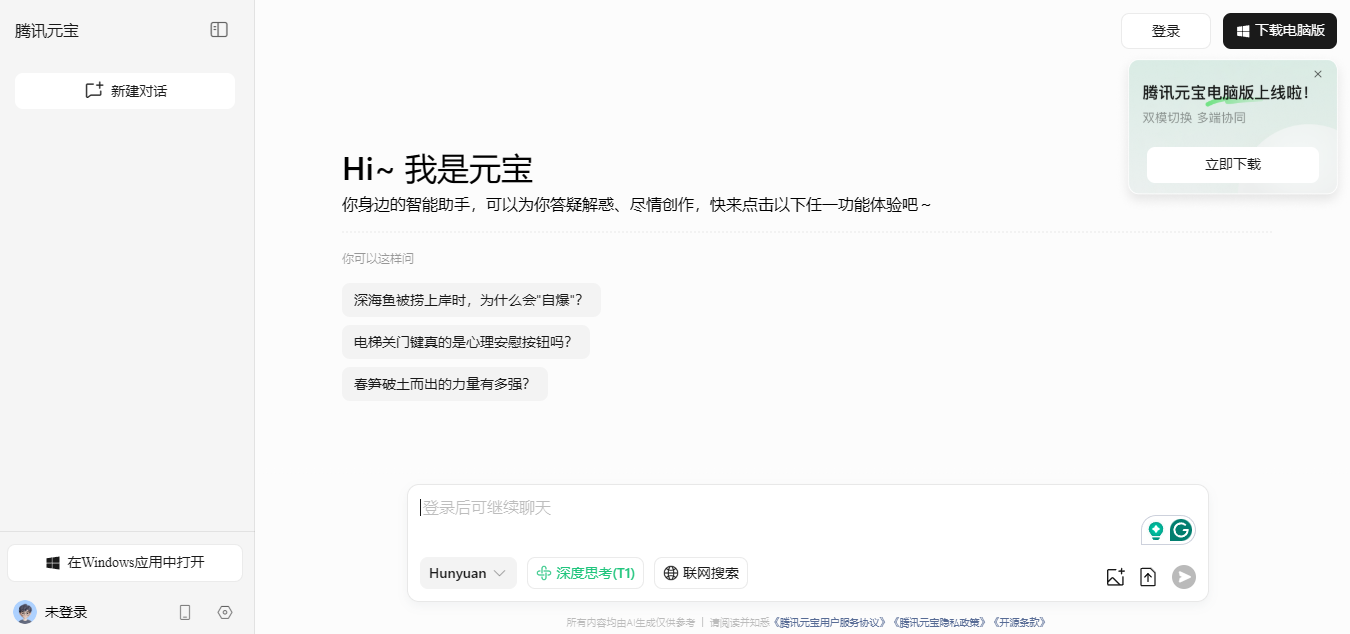
Tencent Yuanbao
Tencent Yuanbao is an AI-driven assistant that has swiftly gained traction in China, utilizing sophisticated large language models, including its own Hunyuan model, while also integrating with DeepSeek. This application stands out in various domains, such as processing the Chinese language, logical reasoning, and executing tasks efficiently. In recent months, Yuanbao's user base has expanded dramatically, allowing it to outpace rivals like DeepSeek and achieve the top position on the Apple App Store download charts in China. A significant factor fueling its ascent is its seamless integration within the Tencent ecosystem, especially through WeChat, which boosts its accessibility and enhances its array of features. This impressive growth underscores Tencent's increasing ambition to carve out a significant presence in the competitive landscape of AI assistants, as it continues to innovate and expand its offerings. As Yuanbao evolves, it is likely to further challenge existing players in the market.
Learn more