Average Ratings 0 Ratings
Average Ratings 0 Ratings
Similar Products
-
EvertuneEvertune is the Generative Engine Optimization (GEO) platform that helps brands improve visibility in AI search across ChatGPT, AI Overview, AI Mode, Gemini, Claude, Perplexity, Meta, DeepSeek and Copilot. We're building the first marketing platform for AI search as a channel. We show enterprise brands exactly where they stand when customers discover them through AI — then give them the precise playbook to show up stronger. This is Generative Engine Optimization, also known as AI SEO. Using applied AI and data science at scale, we give brands statistical confidence in our actionable insights. We decode what gets brands mentioned more and ranked higher, provide reliable brand monitoring and competitive intelligence, then deliver actionable content strategies that move the needle. Our AI SEO and AI search engine optimization tools are built for how LLMs actually work. Why Leading Enterprise Marketers Choose Evertune: Data Science at Scale: We prompt across every major LLM at volumes that capture response variations and ensure statistical significance for comprehensive brand monitoring and competitive intelligence. Actionable Strategy, Not Just Dashboards: Specific content, messaging and distribution tactics that increase your AI search visibility. Dedicated Customer Success: Hands-on training and strategic guidance to turn insights into improved performance in AI search. Built for AI search as a channel: Organic visibility today, paid advertising and commerce tomorrow. Proven Leadership: Founded by The Trade Desk veterans who pioneered data-driven digital advertising. Backed by data scientists from OpenAI, Meta and other AI leaders.
-
PipefyPipefy is a low-code Business Orchestration and Automation Technologies (BOAT) platform designed to act as a modern middleware layer for the enterprise stack. Rather than replacing existing Systems of Record (SORs) like SAP, Oracle, or Salesforce, Pipefy wraps them in an agile orchestration layer. This architecture allows technical teams to modernize legacy operations and extend the life of core systems without the risks associated with "rip and replace" projects. Pipefy provides the infrastructure to sanitize data inputs, manage complex business logic, and orchestrate API calls between fragmented endpoints. Technical & Architectural Highlights: • Adaptive Governance Framework: Pipefy solves the "Shadow IT" problem by establishing IT-sanctioned "Safe Zones." Business users can build workflows within these guardrails, while IT retains control over critical data, integrations, and permissions via a centralized console. • Agentic AI Engine (BYOLLM): The platform features a governable AI Agent Studio. Unlike "black box" solutions, Pipefy supports a Bring Your Own LLM approach, allowing enterprises to integrate preferred models (Azure OpenAI, AWS Bedrock) securely to automate document analysis (OCR) and decision-making. • Robust Connectivity: Built with an API-first philosophy, Pipefy offers a GraphQL API, Webhooks, and enterprise-grade iPaaS capabilities to ensure seamless data interoperability across the stack. • Security & Compliance: Engineered for regulated industries, the platform is ISO 27001, ISO 27701, and SOC2 Type II certified, supporting compliance with GDPR and SOX standards. Pipefy empowers IT leaders to eliminate technical debt and clear development backlogs by safely delegating low-complexity builds to business units.
-
SmoobuSmoobu is an all-in-one vacation rental management software that streamlines operations through a centralized Property Management System (PMS). This powerful command center allows for the professional oversight of all short-term rental operations from a single dashboard. By utilizing a high-speed Channel Manager for real-time calendar synchronization across all major booking platforms, Smoobu ensures accurate availability, effectively preventing double bookings and protecting your reputation. To scale your business, the Booking Engine and integrated Website Builder empower you to drive direct bookings and maximize total revenue. Hosts can further automate their workflow with a Guest Communication module that sends personalized messages and provides a digital Guest Guide for an elevated experience. With Dynamic Pricing to optimize nightly rates and detailed Statistics for performance tracking, Smoobu is the ultimate tool for managing everything—from individual apartments to boutique hotels—in one efficient, high-performance hub.
-
SKU ScienceSKU Science delivers a fast and intuitive solution for sales forecasting and performance tracking. Implement your demand planning process in as little as two days! Created by seasoned experts, it’s specifically designed for operations managers, S&OP managers, supply chain professionals, and demand planners. With 644 statistical combinations, the platform generates highly accurate and tailored sales forecasts at any level. For even greater precision, AI models can be trained on your unique dataset. Automatically calculated KPIs highlight the most critical items, helping you focus on what matters most for your supply chain and business success. The platform’s operational dashboards refresh every cycle, ensuring efficient activity monitoring and data-driven decision-making. Combining advanced capabilities with ease of use, SKU Science is trusted by clients across manufacturing, food and beverage, healthcare, retail, and e-commerce sectors.
-
TrustInSoft AnalyzerTrustInSoft commercializes a source code analyzer called TrustInSoft Analyzer, which analyzes C and C++ code and mathematically guarantees the absence of defects, immunity of software components to the most common security flaws, and compliance with a specification. The technology is recognized by U.S. federal agency the National Institute of Standards and Technology (NIST), and was the first in the world to meet NIST’s SATE V Ockham Criteria for high quality software. The key differentiator for TrustInSoft Analyzer is its use of mathematical approaches called formal methods, which allow for an exhaustive analysis to find all the vulnerabilities or runtime errors and only raises true alarms. Companies who use TrustInSoft Analyzer reduce their verification costs by 4, efforts in bug detection by 40, and obtain an irrefutable proof that their software is safe and secure. The experts at TrustInSoft can also assist clients in training, support and additional services.
-
TrafficGuardWith TrafficGuard, you can put an end to the worry of polluted traffic disrupting your campaign success. Our advanced ML/AI-powered technology identifies and blocks both simple and complex fraudulent traffic in real time, ensuring your ad spend targets genuine, high-quality clicks and conversions. This leads to better campaign outcomes and an enhanced return on ad spend (ROAS). This robust solution safeguards every dollar of your advertising budget, allowing you to concentrate on reaching your marketing objectives without stress. Let TrafficGuard handle ad fraud protection, so you can confidently manage your: Google Search (PPC) campaigns Mobile user acquisition campaigns Affiliate spending Social media advertising In addition to our technology, we provide expert campaign management and exceptional customer support, making us a reliable partner for all your ad fraud protection needs.
-
SmartDrawSmartDraw makes professional drawings and diagrams accessible to everyone. Non-technical users can quickly create floor plans, while professionals get the precision and scale they require. With industry-leading floor planning tools and an intuitive interface for traditional diagramming like flowcharts and organizational charts, SmartDraw delivers enterprise-ready power without unnecessary complexity. Key features: - Large collection of symbols and templates - Ability to create custom shapes - Import PDFs, images, Google Maps, Visio files, Visio stencils - Draw to any scale - Enrich drawings with data - Generate manifest and bills of materials - Generate diagrams from data automatically like org charts, AWS, Azure, PI Boards, and more - Use natural language text prompts to generate diagrams with AI - Save files directly to OneDrive, SharePoint, or Google Drive, or other preferred provider - Integrations with the Microsoft and Google enterprise stack plus Confluence and Jira SmartDraw supports a wide range of industries and real-world use cases, helping teams plan, document, and communicate more effectively. Construction professionals use it to create scaled floor plans, site layouts, and electrical and plumbing drawings. Fire departments rely on it for fire pre-planning and incident documentation, while police departments use it for accident reconstruction and crime scene diagrams. IT teams build network diagrams and cloud architectures, HR leaders create organizational charts, and product managers map out processes and workflows. From physical layouts to business processes, SmartDraw provides a single platform that adapts to the needs of each role and industry.
-
QBenchBuilt for testing laboratories, QBench is a cloud LIMS that brings samples, workflows, lab data, inventory, reporting, quality processes, and client interactions into a single system. From order placement through sample processing, results, and automated reporting, QBench supports every stage of lab operations. Lab teams configure their own workflows, data fields, and automation rules, so the software fits existing processes instead of forcing new ones. When requirements shift, labs can adjust fields, processes, and automations without depending heavily on custom code. Instruments, software, and outside systems connect to QBench through file parsers and a robust API, which moves data automatically and limits repetitive entry and transcription mistakes. For reporting beyond the LIMS, labs can connect QBench to Tableau, Power BI, Domo, or Looker via REST API. What labs get with QBench: Sample and workflow management Configurable workflows and custom data fields Workflow automation Instrument and system integrations File parsing and API connectivity Inventory management A client portal Automated reporting Analytics and operational insights Connections to Tableau, Power BI, Domo, and Looker A built-in Quality Management System (QMS) Because it runs in the cloud, lab teams get secure access to their data, workflows, quality management, and reporting in one centralized platform. Implementation and ongoing guidance come from a team that includes former bench scientists who understand laboratory workflows.
-
ClickLearnClickLearn simplifies complex business processes using popular software. You can create multi-format learning materials in any language and publish them to a 24/7 learning portal with just one click. A video walkthrough of the process, with narration in your preferred language. Put your learning to the test. This interactive simulation of your workplace allows you to test your knowledge without any hints. Interactive simulation of your workplace environment that guides you through the process. This guide is step-by-step. ClickLearn wrote this guide with perfectly cropped screenshots. ClickLearn Assist can be your go-to helper when you are stuck, need process help, or want to try a new process in the live system. You don't have to worry about making another mistake. All your learning materials can be auto-translated with a click of a button
-
Google Cloud Speech-to-TextAn API powered by Google's AI technology allows you to accurately convert speech into text. You can accurately caption your content, provide a better user experience with products using voice commands, and gain insight from customer interactions to improve your service. Google's deep learning neural network algorithms are the most advanced in automatic speech recognition (ASR). Speech-to-Text allows for experimentation, creation, management, and customization of custom resources. You can deploy speech recognition wherever you need it, whether it's in the cloud using the API or on-premises using Speech-to-Text O-Prem. You can customize speech recognition to translate domain-specific terms or rare words. Automated conversion of spoken numbers into addresses, years and currencies. Our user interface makes it easy to experiment with your speech audio.
Description
R is a comprehensive environment and programming language tailored for statistical analysis and graphical representation. As a part of the GNU project, it shares similarities with the S language, which was originally designed by John Chambers and his team at Bell Laboratories, now known as Lucent Technologies. Essentially, R serves as an alternative implementation of S, and while there are notable distinctions between the two, a significant amount of S code can be executed in R without modification. This versatile language offers a broad spectrum of statistical methods, including both linear and nonlinear modeling, classical statistical tests, time-series analytics, classification, and clustering, among others, and it boasts a high level of extensibility. The S language is frequently utilized in research focused on statistical methodologies, and R presents an Open Source avenue for engaging in this field. Moreover, one of R's key advantages lies in its capability to generate high-quality publication-ready graphics, facilitating the inclusion of mathematical symbols and formulas as needed, which enhances its usability for researchers and analysts alike. Ultimately, R continues to be a powerful tool for those seeking to explore and visualize data effectively.
Description
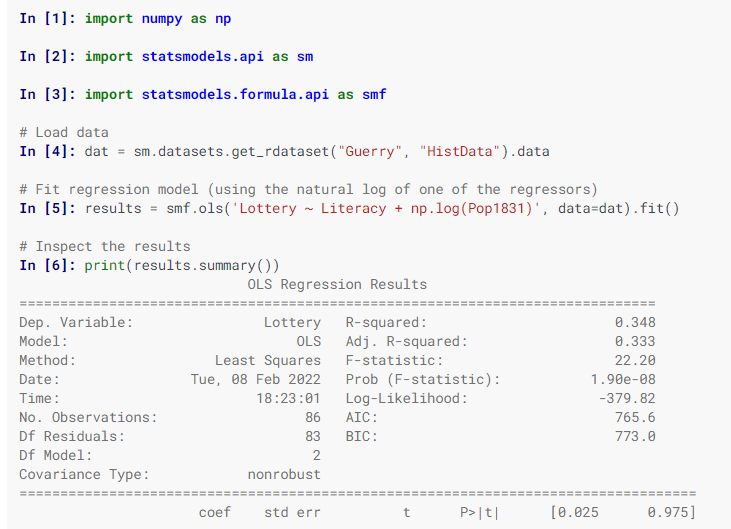
Statsmodels is a Python library designed for the estimation of various statistical models, enabling users to perform statistical tests and explore data effectively. Each estimator comes with a comprehensive array of result statistics, which are validated against established statistical software to ensure accuracy. This package is distributed under the open-source Modified BSD (3-clause) license, promoting free use and modification. Users can specify models using R-style formulas or utilize pandas DataFrames for convenience. To discover available results, you can check dir(results), and you will find that attributes are detailed in results.__doc__, while methods include their own docstrings for further guidance. Additionally, numpy arrays can be employed as an alternative to formulas. For most users, the simplest way to install statsmodels is through the Anaconda distribution, which caters to data analysis and scientific computing across various platforms. Overall, statsmodels serves as a powerful tool for statisticians and data analysts alike.
API Access
Has API
No
API Access
Has API
Yes


Integrations
CZ CELLxGENE Discover
Yes
Claude Fable 5.1
Yes
Cohere
Yes
DeepSeek Coder
Yes
DeepSeek-V4
Yes
Devin
Yes
GLM-5.1
Yes
GPT-5.6 Luna
Yes
Gemini 3 Deep Think
Yes
Gemini Code Assist
Yes
Integrations
CZ CELLxGENE Discover
No
Claude Fable 5.1
No
Cohere
No
DeepSeek Coder
No
DeepSeek-V4
No
Devin
No
GLM-5.1
No
GPT-5.6 Luna
No
Gemini 3 Deep Think
No
Gemini Code Assist
No
Pricing Details
Free
Free Trial
No
Free Version
Yes
Pricing Details
Free
Free Trial
No
Free Version
Yes
Deployment
Web-Based
Yes
On-Premises
Yes
iPhone App
No
iPad App
No
Android App
No
Windows
Yes
Mac
Yes
Linux
Yes
Chromebook
Yes
Deployment
Web-Based
No
On-Premises
No
iPhone App
No
iPad App
No
Android App
No
Windows
Yes
Mac
Yes
Linux
Yes
Chromebook
No
Customer Support
Business Hours
No
Live Rep (24/7)
No
Online Support
Yes
Customer Support
Business Hours
No
Live Rep (24/7)
No
Online Support
Yes
Types of Training
Training Docs
Yes
Webinars
No
Live Training (Online)
No
In Person
No
Types of Training
Training Docs
Yes
Webinars
No
Live Training (Online)
No
In Person
No
Vendor Details
Company Name
The R Foundation
Website
www.r-project.org
Vendor Details
Company Name
statsmodels
Website
www.statsmodels.org/stable/index.html
