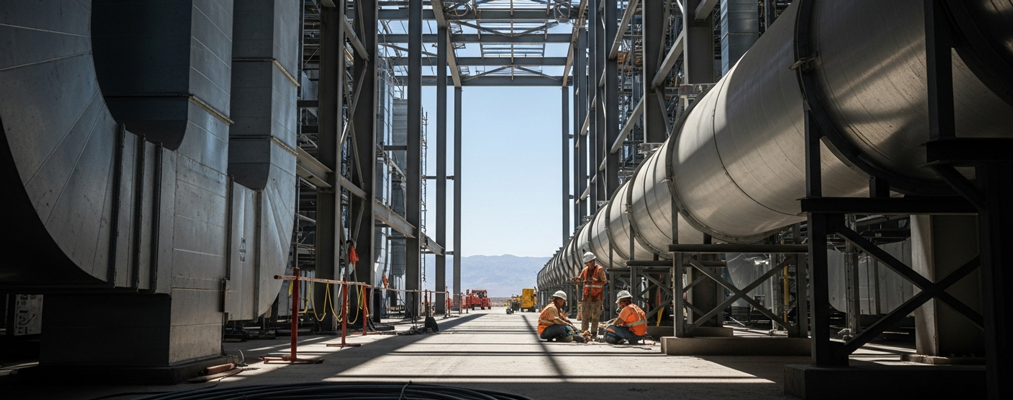
For decades, x86 architecture hummed along quietly in predictable, manageable server farms. That era is over. A significant surge in regional power demand from AI computing is driving a frantic construction boom of hyperscale data centers across Nevada and the US Southwest.
Construction crews are pouring concrete under historic early-spring heat warnings. Scaling AI isn’t just about software constraints or silicon yields anymore; it’s an engineering war against the laws of thermodynamics. And the workers laying rebar and pulling copper in triple-digit heat are caught in the crossfire.
The Thermodynamics of the 2026 AI Boom
When Servers Alter the Climate
The physical footprint of modern AI hyperscalers (often spanning well over a million square feet) is altering local surface temperatures in measurable ways. A University of Cambridge study found that data centers are creating concentrated “heat islands,” warming nearby land by up to 16°F (9.1°C). That thermal exhaust is already affecting over 340 million people globally.
Additionally, Arizona State University research shows a persistent heat plume extending into neighborhoods regardless of wind direction. For residents already dealing with brutal desert summers, this localized warming pushes mortality risks even higher.
Power Density and Transient Spikes
Traditional thermal models are falling apart under AI workloads. The industry is aggressively shifting from standard 5-to-10kW racks to extreme high-density training clusters that push 30 to 100kW per rack. Some advanced liquid-cooled GPU setups are hitting 200-250kW. That’s a staggering amount of heat packed into a very small space.
Here’s where it gets really ugly. Unlike legacy web servers, GPU workloads don’t draw power steadily. They fire in massive, synchronized bursts. A transient spike across a processing cluster can trigger a 30 to 40 percent swing in power demand within milliseconds, frequently tripping upstream electrical protections. Engineers are being forced to rethink entire power distribution topologies just to keep the silicon running.
The Flesh-and-Blood Compilers: Building the Infrastructure
The Six-Figure Trade Worker Rush
The race to bring gigawatt-scale facilities online has triggered a labor scramble across the American Southwest. A single hyperscale site routinely requires thousands of tradespeople (from high-voltage electricians to specialized HVAC techs) to meet punishing 18-month construction timelines. The pay is pulling workers away from traditional commercial construction projects in droves.
Specialized roles command serious premiums. Controls technicians managing complex building automation systems are earning premiums of 30-40 percent over standard rates. The rationale is straightforward: employers hope that higher pay will compensate for the intense physical demands of constructing digital monoliths in the desert.
Occupational Hazards in the Desert
Building dense computing environments in the Nevada desert takes a severe physical toll, especially during unpredictable early-spring heatwaves. The combination of intense ambient heat and breakneck construction pace makes heat exhaustion and on-site injuries practically inevitable. Sound familiar to anyone who’s worked a Southwest construction site? Multiply that risk by the compressed timelines and electrical complexity of a hyperscale build.
When tradespeople collapse or get hurt, the immediate concern shifts from deadlines to dollars. Injured workers and their families often find themselves asking, “How much does workers’ compensation pay in Las Vegas?“ just to figure out if they can keep the lights on during recovery. For injuries in the fiscal year starting July 1, 2024, Nevada’s maximum disability benefit caps at $5,630.43 per month, calculated at 66 2/3 percent of the worker’s average monthly wage.
Permanent partial disability? That pays 0.6 percent of your average monthly wage for each percentage point of physical impairment assigned. And in the most tragic cases where a site hazard proves fatal, state law provides a maximum of just $10,000 for funeral and burial expenses.
Cooling the Uncoolable
Evaporative vs. Direct-to-Chip
Dissipating the extreme thermal loads from AI clusters forces a brutal tradeoff: immense water consumption or highly complex liquid plumbing. Traditional evaporative cooling towers work by evaporating millions of gallons of water, then discharging concentrated mineral blowdown into local municipal systems. If that approach persists, researchers project AI data centers could rival NYC’s water consumption by 2030.
Hardware manufacturers are pushing hard toward direct-to-chip liquid cooling as an alternative. By capturing heat directly at the silicon, these designs can reduce cooling energy by 30-60%. But retrofitting liquid manifolds into legacy air-cooled facilities introduces real operational risk. Operators have to weigh environmental sustainability against the stability of hardware that’s already running production workloads.
| Cooling Method | Heat Removal Efficiency | Rack Density Limit | Water Consumption | Retrofit Complexity |
|---|---|---|---|---|
| Traditional air cooling (CRAC) | Low | 10kW–15kW | Minimal | None (standard) |
| Evaporative cooling towers | Medium | 20kW–30kW | Extremely high | Moderate |
| Direct-to-chip liquid | High | 80kW–100kW+ | Low (closed loop) | High |
| Immersion cooling | Very high | 200kW–250kW | Near zero | Extremely high |
Engineering for AI Intensity and Human Safety
Mitigating Site Risks
The pressure to deploy AI compute capacity is so intense that standard safety protocols are constantly under threat from schedule compression. Project managers routinely try to squeeze traditional 36-month construction and commissioning cycles into 18-month windows. That pace introduces serious safety drift, where critical testing phases overlap with active heavy construction. Not a great recipe for keeping people alive.
To manage both hardware failures and human injuries, hyperscale operators are implementing strict site management protocols. Here are some of the key measures being adopted:
- Mandatory micro-breaks in climate-controlled recovery tents every 45 minutes of active labor whenever ambient temperatures exceed 95°F.
- Accelerated deployment of 800-volt DC systems to cut energy losses and simplify power distribution architecture.
- Strict adherence to Nevada’s temporary partial disability protocols, so injured workers can transition to light-duty administrative roles for up to 24 months without total income loss.
- Advanced DCIM (Data Center Infrastructure Management) platforms that predict thermal runaways before they require dangerous manual intervention.
A Solution in Search of a Coolant?
The shift from “build anywhere” to “build where power exists” defines the 2026 data center landscape. You can’t outrun thermodynamics with clever software or optimistic sustainability reports. The tech industry is constructing the most thermally intense, structurally fragile buildings modern engineering has ever attempted, while straining electrical grids, depleting water tables, and putting workers in genuinely dangerous conditions.
So the question stands: is closed-loop liquid cooling the breakthrough that finally stabilizes all of this, or is the industry engineering itself into a thermal corner with no exit?
Related Categories