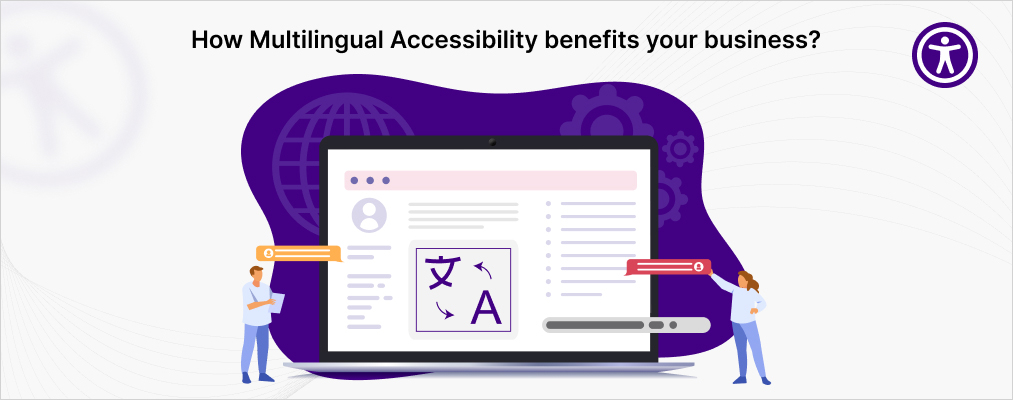
The digital economy doesn’t stop at borders anymore – and neither do businesses. Today, growth often means connecting with people across countries, cultures, languages, and assistive technologies all at the same time.
The way we communicate has changed rapidly. Social media, AI-driven translations, video calls, and real-time digital platforms are now part of everyday life. People expect to interact online in a language they’re comfortable with, and technology has made that expectation feel completely natural. As a result, multilingual communication has become a powerful way for businesses to build trust and stay relevant.
Businesses are blending languages and local context into their content to connect with wider, more diverse audiences.
The numbers back this up. In the U.S., more than 68 million people speak a language other than English at home, and Spanish-speaking users represent the second-largest digital audience in North America. In the UK, post-Brexit migration trends have increased language diversity, especially for digital and public-facing services.
This is where multilingual accessibility becomes a strategic advantage – supporting inclusive user experiences, improving global engagement, and strengthening enterprise-level digital maturity.
Can a screen reader user navigate every language version of your website as smoothly as the primary one?
If the answer is unclear, multilingual accessibility deserves attention. Let’s understand!
Multilingual accessibility: Its sum and substance!
Multilingual accessibility refers to the practice of making digital content – such as websites, web applications, social media, and mobile apps usable and understandable for people with disabilities across multiple languages, regions, and assistive technologies.
- Language accessibility involves localization, translation, and cultural adaptation – tailoring digital experiences to different linguistic and regional contexts.
- Web accessibility ensures that digital interfaces comply with international standards such as the Web Content Accessibility Guidelines (WCAG), European Accessibility Act (EAA), and Americans with Disabilities Act (ADA), UK Equality Act, Section 508, ATAG 2.0, Australian DDA Compliance, Switzerland DDA Act, Indian RPD act, German BITV and BGG Act, Accessibility Canada Act (ACA), France RGAA, Italian Stanca Act, California Unruh Act making them usable for people with visual, auditory, cognitive, or motor impairments.
- A commitment to multilingual accessibility shows that a brand genuinely values DEI – diversity, equity, and inclusion. By offering accessible, language-inclusive experiences, enterprises present themselves as socially responsible and focused on every user.
- Accessible, localized interfaces work better for everyone – whether users have a disability, or simply prefer their native language. By investing in multilingual accessibility, enterprises create intuitive, culturally relevant experiences that boost satisfaction, increase engagement, and strengthen customer relationships.
- Search engines increasingly favor websites that follow accessibility best practices and offer multilingual content. Accessible, localized pages rank better, improve discoverability, and help enterprises gain stronger organic visibility across global markets.
The quantifiable impact multilingual accessibility brings to enterprises!
When enterprises invest in multilingual accessibility, the business upside is more than anecdotal. Following are some key findings and examples that illustrate the measurable value.
- Accessible websites reach a larger audience
Around 15% of the world’s population lives with some form of disability, and thus, failure to provide accessible content means missing a significant market.
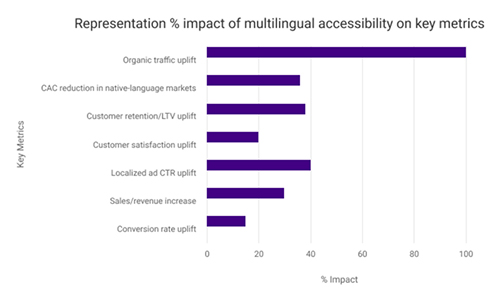
With an improved accessibility, websites report measurable gains: for example, one analysis found that websites that implemented accessibility improvements saw an average increase of 12% in organic traffic. Find more information: https://www.semrush.com/news/242494-study-is-web-accessibility-key-to-driving-organic-traffic/
- Multilingual/localized websites show higher conversion and regional performance
a. A source report (https://www.shopify.com/enterprise/blog/ecommerce-localization) presents that ecommerce websites that cater to language preferences and offer content based on customer’s location see 10% to 15% higher conversion rates and 20% greater customer satisfaction.
b. Also, ecommerce platforms with localized websites see a decent increase in overall sales and ROI within their first year of launching multilingual versions.
c. Localized ads can deliver almost 42% higher CTR compared with English-only campaigns.
(Read more statistics about ecommerce and latest trends from here: https://www.hostinger.com/in/tutorials/ecommerce-statistics)
For enterprises looking to scale multilingual accessibility without disrupting existing digital infrastructure, adopting a flexible accessibility solution or widget can be a practical next step. Modern accessibility tools help support language-specific screen reader compatibility, user-friendly navigation, readable content options, and accessible multimedia – across websites and applications. By integrating an enterprise-ready accessibility widget, organizations can improve usability for global audiences while supporting evolving accessibility standards and long-term digital growth.

All in One Accessibility®: A quick, scalable and impactful multilingual accessibility widget for enterprises!
For enterprises managing multiple global websites and applications, implementing accessibility and language inclusivity at scale can be a daunting challenge. This accessibility widget simplifies the process by offering a comprehensive multilingual functionality and seamless integration across enterprise ecosystems.
Built to improve both accessibility and usability, this widget helps organizations create inclusive digital experiences for all users – no matter their language or location.
Key multilingual features
- Automatic language detection: The widget intelligently detects the user’s browser language and adjusts the interface, accordingly, ensuring an inclusive experience from the first interaction.
- Support for 140+ languages: This multi-language accessibility widget provides accessibility features and interface options in over 140 languages, enabling global organizations to reach diverse user groups effortlessly.
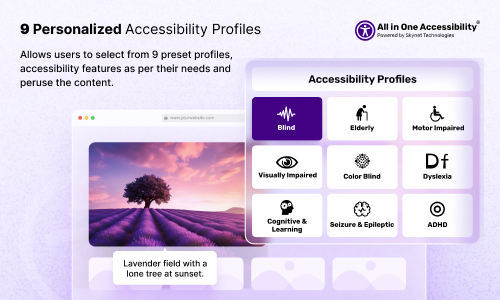
- Localized accessibility profiles: Users can select accessibility profiles (such as “Blind”, “Motor Impaired”, “Color Blind”, “Dyslexia”, “Visually Impaired”, “Seizure & Epileptic”, “Elderly”, “ADHA” or “Cognitive & Learning”) in their native language, combining localization and accessibility for personalized usability.
AI-powered accessibility remediation
The All in One Accessibility® widget leverages AI-driven automation to identify and resolve common accessibility issues – such as missing alt text, improper heading structures, or low contrast – within seconds. This accelerates compliance with WCAG 2.1, 2.2, ADA, Section 508, EAA, and other global standards while reducing manual workload for enterprise teams.
Seamless enterprise integration
The widget integrates effortlessly with any website or web application, regardless of the CMS or any tech stack. From enterprise portals and SAAS platforms to ecommerce storefronts, it ensures consistent accessibility across all digital touchpoints without disrupting existing workflows or site performance.
Moreover, it has a centralized dashboard that helps enterprises to manage multiple digital properties from a single place. The widget’s interface is customizable, and it also offers analytics reports to track how users engage with accessibility features globally.
With its scalability, multilingual capability, and AI-powered automation, it empowers enterprises to strengthen inclusivity, and enhance their digital brand experience – without the complexity of manual remediation. However accessibility audit, website accessibility remediation, ongoing monitoring, VPAT / ACR Report service) is required, and available as premium add-ons within this widget for extended accessibility improvements and compliance.
Multilingual accessibility strengthens enterprise compliance reporting – How?
Multilingual accessibility refers to enhanced user experience along with many other advantages like enterprise compliance reporting. When organizations operate across multiple regions, ensuring that accessibility standards and documentation are available in multiple languages reflects a genuine commitment to global inclusivity and transparency.
By aligning multilingual accessibility with compliance initiatives, enterprises can:
- Create region-specific accessibility reports and Voluntary Product Accessibility Template (VPAT) Report that accurately represent local compliance status under laws.
- Demonstrate DEI (Diversity, Equity, and Inclusion) goals in action by making compliance documentation understandable and accessible to global teams, regulators, and customers.
- Strengthen audit readiness, as multilingual accessibility ensures consistent accessibility standards across all localized versions of digital platforms.
The combination of accessibility widget and manual accessibility remediation services simplifies this reporting process significantly and achieves consistent accessibility across all locales.
The future of multilingual accessibility in enterprises
The future of enterprise accessibility is being shaped by AI, automation, and global inclusion mandates. Technologies like AI-driven translation, natural language processing (NLP), and automated accessibility auditing tools are making it easier than ever for organizations to scale accessible, multilingual experiences. With these innovations, content can adapt in real time – delivering accessible, localized experiences instantly, no matter the user’s region or device.
At the same time, global regulations are evolving to push inclusive digital communication even further. Frameworks like the EAA, upcoming WCAG updates, and regional mandates worldwide are setting expectations beyond basic compliance. Enterprises will need to provide multilingual content, assistive interfaces, and inclusive design as standard practice.
Proactive adoption builds stronger brand trust, smooths global expansion, and drives long-term efficiency by embedding accessibility into the heart of digital transformation. In the coming years, multilingual accessibility won’t be optional – it will define how successful, inclusive enterprises operate.
So, what are you waiting for? Is your website multilingual and accessible? Reach out at hello@skynettechnologies.com to discover scalable solutions for global accessibility compliance.
Related Categories