
This is the story of a $97 billion industry threatened by technological change.
What makes this story remarkable is that the industry not only evolved successfully to meet the challenge, but also that it was transformed by an industry leader with a market capitalization of more than $282 billion. This is a story of reinvention, in other words, not one of upstart disruption.
The industry in question is ERP, the end-to-end business software that powers all mid-sized to large businesses and many smaller firms as well. The reformer, interestingly, is the inventor of ERP itself: SAP.
ERP Before the Cloud: Useful, But Big and Complex
The ERP market before the cloud was a technology universe unto itself. What started as manufacturing resource planning (MRP) in the 1960s evolved over time into an end-to-end software solution for running all aspects of business from accounting and financials to inventory, logistics, and human resources. By the 1980s, ERP came to serve as the backbone for corporate IT.
But this was a world predominantly for larger enterprises, because ERP was hulking, complex, and both costly to implement and maintain. Businesses spent years planning and rolling out a new ERP solution, and they had to invest both in dedicated hardware and IT staff that would maintain it, not to mention the considerable cost of ERP consultants and the software licenses themselves.
Traditional ERP solutions housed all of a company’s data, and connected it with applications and third-party systems. But these connections were not always easy to set up, and ERP system upgrades were a big deal because they interfaced with pricey legacy hardware investments, required adjusting complex custom code, and took careful monitoring to ensure they did not break some part of the company’s operational stack.
Cloud Computing and a Reckoning
Things began to change when cloud computing accelerated the business cycle in the early 2000s and altered business models.
Software-as-a-service emerged, enabling businesses to rent software in the cloud and scale it as needed without a high learning curve or any hardware investment. Easy system connectivity became important as e-commerce and cloud services developed, and the sharing of real-time data exploded. Data-driven decision-making increased with the rise of real-time data sharing and increased digitalization. Nimbleness and agility became important as the pace of technology and competition increased, and social media moved trends faster. Employees and businesses also began leaning on consumer software more as the line between business software and consumer solutions narrowed.
Artificial intelligence also emerged more recently, a game-changing and fast-moving technology that relies on the cloud and doesn’t play easily with hulking, slow-to-adapt on-premise ERP software.
ERP was in trouble. Fortune 500 companies still relied on it, but industry-leading solutions such as the SAP S/4HANA ERP looked like a dinosaur out of touch with technology changes and ill-equipped for what lay ahead. Smaller businesses also couldn’t use the software and were turning to other cloud-based solutions as they scaled.
Early Attempts at Cloud ERP
These changes did not go unnoticed by the ERP industry, of course.
As early as 1998, NetSuite began working on a cloud-based ERP solution that reduced complexity and met many of the challenges posed by the cloud model. For its part, market leader SAP also began experimenting with cloud ERP and released a popular cloud-based ERP for smaller businesses, SAP Business ByDesign. Private cloud implementations of traditional ERP also debuted.
These cloud-based ERP solutions opened the market up to smaller firms, and they enabled larger enterprises to tap into some of the power of cloud computing. But there still was a big problem: ERP is inherently complex as an end-to-end software solution, which makes it hard to adopt and slow to adapt. The very premise of ERP was inconsistent with the cloud and its reliance on constant iteration and standardized system design.
Small and fast-growing companies were reaping the benefits of cloud ERP, but they hit a massive wall of cost, rigidity, and complexity when they outgrew the simple functionality of their small-business cloud ERP and had to migrate to a traditional ERP housed on a private cloud server.
Larger businesses, meanwhile, were delaying their migration to the cloud or getting on with a private cloud version of their legacy ERP that kinda, sorta delivered on the promise of the cloud era but not really.
ERP wasn’t keeping up. It was in the cloud, but it was not really built for the future.
SAP Reinvents ERP for the Cloud
The death of traditional ERP came slowly, then all at once.
While many businesses were still using on-premise ERP and some were already in the cloud, in 2015 SAP released a full cloud-native version of its S/4HANA flagship ERP. The tech consultancy Gartner called this a “transformational shift” at the time, and noted that it was the biggest update to SAP’s ERP strategy in more than two decades. But SAP was just getting started.
Over the next several years, SAP quietly re-engineered its flagship ERP from the ground up and built an entirely new model around it that embraces cloud methodologies and represents a radical reinvention of ERP. At the same time, it continued to support and sell its older, legacy offerings as it built out this entirely new solution. This was the slow part.
The fast part happened just last year, when SAP signaled the death of traditional ERP with its now tested and newly rebranded SAP Cloud ERP.
Traditional, hulking ERP is dead. Instead of a large software solution that is heavily customized for the needs of a given business, SAP Cloud ERP is now a public cloud-based core that provides only basic logic and API hooks. Applications, cloud services, and third-party systems then connect and sit on top of this core. Through this, SAP Cloud ERP orchestrates and unifies operations without actually handling most business functions directly.
This modular, radical reinvention brings several benefits.
- Cloud-native architecture – SAP Cloud ERP serves as a universal orchestration layer instead of attempting to be an all-in-one software solution that has been ported to the cloud.
- Flexibility as things change – The modularity of SAP Cloud ERP means that it can rapidly evolve and iterate as technology changes without breaking existing workflows or forcing new processes on businesses before they are ready.
- Configuration instead of customization – Adapting the system for the particular needs of a given business entails configuration instead of customization in most situations, which improves agility and faster rollout times.
- Fit-to-standard methodology mixed with adaptability – Businesses can start with industry-standard best practices instead of reinventing the wheel, but they still can create bespoke processes and configurations where needed.
- Scalability so businesses can grow and evolve – The same ERP works for smaller businesses and large enterprises alike because the common core allows for the swapping of basic processes and applications for more industrial-strength solutions as a business grows.
Although SAP still offers a small business edition and a private cloud version of its flagship ERP, it has clearly signaled that SAP Cloud ERP represents a single platform that will meet the needs of most businesses today and as they grow.
A Business Platform, Not Really an ERP
While meeting the same core need, a universal system of record that powers a business end-to-end, SAP has effectively killed ERP and replaced it with a universal cloud platform. This is clear from the relationship between SAP Cloud ERP and the larger SAP Business Suite.
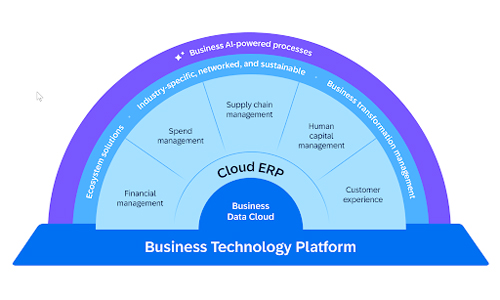
The SAP Business Suite by Navigator Business Solutions, is a cloud ecosystem that powers a business end-to-end, much like ERP in the on-premise age, but with several new tricks.
The Business Suite starts with SAP Cloud ERP, of course, and the orchestration layer that ties it all together. Data and functionality do not live in the ERP, however.
Workflows and actual business functions take place instead in the individual applications that connect with SAP Cloud ERP, both SAP applications such as SuccessFactors for human resources and Ariba for supply chain, and third-party applications that connect with the system. Data lives in the SAP Business Data Cloud, a fully managed SaaS solution that centralizes and governs all business data while seamlessly integrating with third-party data and exposing it to applications within the Business Suite where appropriate.
The Business AI layer within the SAP Business Suite adds artificial intelligence to the mix. Agentic AI can answer questions based on data within the system and perform actions on behalf of employees, bringing a level of automation and analytics that legacy ERP cannot match. Businesses can choose to incorporate any of the popular AI models with their system, including ChatGPT, Anthropic’s Claude, or Google Gemini, which highlights the future-proof nature of the architecture.
Integrations, third-party add-ons, and no-code/low-code customization take place through the SAP Business Technology Platform (BTP), an online marketplace and development environment that makes it easy for companies to extend the Business Suite in any way that is required without directly modifying the underlying platform.
This constellation of applications and services still acts like an ERP when taken in aggregate, and indeed, SAP Cloud ERP plays a central role in the stack. But this is no longer an ERP; it is an all-encompassing platform for running a business and unifying its data.
The cloud killed traditional ERP, and SAP replaced it with something much better.
Related Categories