Point solutions each see a slice of what happens on a device. In the age of AI agents, only the endpoint sees the whole picture.
For twenty years, enterprise security was engineered around one assumption: a human being is the one clicking, typing, logging in, and moving data. Every control, the DLP policy, the EDR baseline, the “is this normal for this user” model, was tuned to human behavior. Generative AI has quietly retired that assumption, and most security stacks haven’t caught up.
The deeper problem isn’t any single new attack. It’s a context gap: your tools can each see a fragment of what happens on a device, but no single tool sees the whole picture, who or what acted, on which data, at the moment it mattered. Gen AI has widened that gap faster than any technology in recent memory.
A threat landscape rewritten by Gen AI
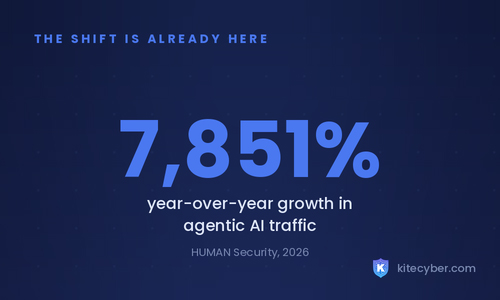
The numbers describe a shift already underway, not a forecast. Automated traffic is now growing roughly eight times faster than human traffic online, and agentic AI traffic which includes software actually taking actions, not just crawling pages, surged 7,851% year over year, according to HUMAN Security’s 2026 benchmark research. Inside the enterprise the change is sharper: non-human identities, including service accounts and AI agents, now outnumber human identities about 45 to 1, up from 17:1 in 2023, per Cloud Security Alliance research. Gartner expects 40% of enterprise applications to embed task-specific AI agents by the end of 2026, up from under 5% a year earlier.
Two behaviors make this hard to govern. First, data now moves at machine speed and changes shape: a customer list pasted into ChatGPT, uploaded to a chatbot, screenshotted, or re-encoded to slip past a scanner. Second, adoption is outrunning oversight: 78% of employees report using AI tools without IT approval, and 38% admit to sharing confidential company data with those tools, according to WalkMe’s 2025 survey. Security teams are being asked to protect data flowing through applications they don’t know exist, driven by actors they can’t see.
The context gap in existing solutions
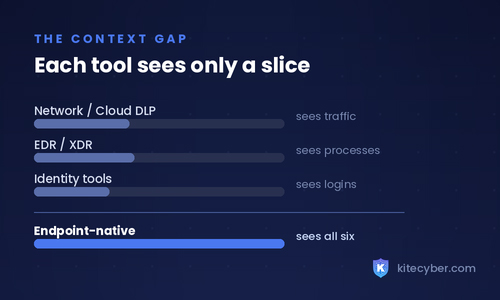
The instinct is to buy another tool. But the tools already in place each see only a slice of the story, and the slices don’t add up to a picture.
Network and cloud-delivered controls — SASE, network DLP, CASB, sit downstream of the endpoint. They see traffic leaving, not the application-layer decision that produced it. They can flag a large upload but can’t tell whether a person dragged a file into a browser or an agent read a spreadsheet, summarized it, and pasted the result into a chat window. Traffic without context.
EDR and XDR were built to catch malware and anomalous processes. They were never designed to distinguish a legitimate AI agent reading a file from the logged-in user reading the same file. The tool isn’t malfunctioning, it’s blind to a category of actor it was never trained to watch.
Identity tools weren’t built for the new ratio either. CSA found that 53% of organizations can’t enumerate even half of the machine identities in their own environment so most teams are already flying blind on the very actors multiplying fastest. The result is familiar to any CISO: fragmented alerts, hours spent stitching disconnected logs together after the fact, and enforcement that arrives long after the data has left.
Why the endpoint closes the gap
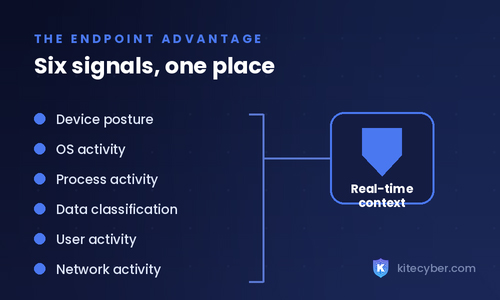
There is exactly one place where all of this context converges before data moves: the endpoint. It is the only vantage point that can see, together and in real time, six signals that elsewhere live in separate systems: device posture, operating-system activity, process activity, data classification, user activity, and network activity.
Seeing those signals in one place changes what’s possible. Context plus point-of-action means a policy can allow, warn, or block a specific data movement in the same instant the interaction happens, not surface it three weeks later in a report. It also means an organization can finally tell the difference between a person and the agents acting on that person’s behalf, because it can watch the process and the user together rather than inferring one from network traffic.
Kitecyber’s architecture
Kitecyber is built on that principle. Instead of bolting agent visibility onto a network proxy or adding another console, it runs as a single lightweight agent on the endpoint and unifies capabilities that are usually separate products: DLP, secure web gateway, ZTNA/ZTPA, SaaS protection, and Gen AI security. The six context signals are the foundation, not an add-on.
Because classification and enforcement happen on the device, sensitive content doesn’t have to be shipped to the cloud to be evaluated, and action can be taken at the source. The agent deploys in about a day, runs at a claimed sub-2% CPU overhead, and the platform is backed by SOC 2 Type II and ISO 27001. Critically, DLP and Gen AI security are the same engine carrying the same context and not adjacent modules that each see half the story.
What full context enables: DLP and Gen AI security
For data loss prevention, Kitecyber classifies content using LLM-based, context-aware analysis across 80-plus categories like PII, PHI, PCI, source code, intellectual property, with an accuracy above 90% as seen in practice, rather than matching against static patterns and keywords. It tracks data lineage
through transformation, so a spreadsheet of customer records is still recognized after it’s screenshotted, encoded, or converted into a format built to fool content scanners. And when something goes wrong, it auto-generates a full incident report in minutes, with no historical baseline required.
For Gen AI security, the same agent tracks sensitive data pasted or uploaded into tools like ChatGPT, Claude, and Gemini and can block it before it leaves the device. It discovers shadow AI across the endpoint and gives visibility into how AI agents behave once they’re operating on it. All enforced at the point of contact, where the data actually is.
Closing the gap
The question CISOs and IT leaders should be asking is no longer “are our people following policy.” It’s “do we know what’s acting on our endpoints, and what it’s touching.” Answering that requires context only the endpoint can provide and a platform designed to act on it in real time. That is the gap Kitecyber was built to close.
Learn more at kitecyber.com
Related Categories