If 2024 and 2025 were the years AI arrived in contract management, 2026 is the year it has to prove something. Every CLM vendor has added “AI-powered” to their marketing page. Every legal department has at least run a pilot. But as one longtime contract manager recently laid out in detail, the industry has a habit of citing stats without scrutinizing them, and the gap between what vendors promise and what buyers can actually verify is getting harder to ignore.
Ten stats, ranked by how much they should change the way you think about AI in contract management right now.
1. Only 13 percent of AI decision-makers report a positive EBITDA impact from their AI investments
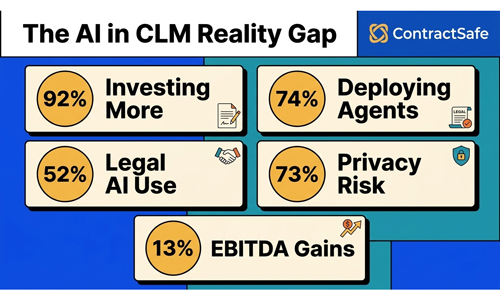
That number comes from Forrester’s 2025 State of AI Survey, which covered more than 1,400 global AI decision-makers actively deploying the technology. Fewer than a third can tie AI contributions to P&L at all. The most striking data point of 2026 isn’t about adoption. It’s about return. Most companies are spending on AI without being able to show what they got for it. For contract management specifically, this is why vague “AI-powered” claims are increasingly met with harder questions about what the AI is actually doing.
2. 92 percent of companies plan to increase AI investments, but only 1 percent call themselves mature
McKinsey’s January 2025 workplace report surveyed 3,613 employees and 238 C-suite executives. The hype-to-reality gap in a single stat. Most companies are spending more on AI every year while almost none have integrated it into workflows in a way that actually drives business outcomes. Investment is not the same as adoption. Adoption is not the same as value.
3. Only 21 percent of companies have a mature governance model for autonomous AI agents
From Deloitte’s State of AI 2026 report (n=3,235 business and IT leaders). Agentic AI is coming fast to contract management. Ironclad launched agents in March 2026. Juro has been shipping them. Every major CLM vendor now has an agent story. But fewer than one in five organizations has the governance in place to deploy them safely. When an agent can execute a redline, send a communication, or modify a record without human approval, the gap between capability and control becomes an operational risk. ContractSafe’s approach keeps a human in the loop on every AI output through a review-adjust-accept workflow, with the AI able to be turned off entirely if you want.
4. 74 percent of companies plan to deploy agentic AI within two years
Also from the Deloitte report. Today, 23 percent use agentic AI at least moderately. In two years, that jumps to 74 percent, with 5 percent fully integrating agents as a core operational component. Pair this with stat #3 and the picture is clear: the deployment curve is steeper than the governance curve. The companies that build governance first will be in a stronger position than those that build agents first and scramble to govern them later.
5. 73 percent cite data privacy and security as their top AI risk concern
Deloitte again, this time from the risk-concerns chart. Legal compliance (50 percent) and governance capabilities (46 percent) round out the top three. This is the stat that matters most for CLM buyers: your contracts contain the most sensitive data in your business. If a vendor’s AI is training on your customer data, or if the vendor can’t tell you clearly whether it is, that’s a deal-breaker for most legal and procurement teams. ContractSafe’s AI doesn’t train on customer data, maintains SOC 2 Type 2, ISO 27001, and HIPAA compliance, and has published an EU AI Act posture committing to no automated decision-making.
6. Generative AI use in corporate legal departments jumped from 23 percent to 52 percent in one year
An October 2025 ACC and Everlaw survey of 657 in-house legal professionals across 30 countries. The pace of legal-specific AI adoption is what makes the governance and ROI stats above urgent. Legal departments are moving from pilots to production fast, and 64 percent say they expect to rely less on outside counsel because of the AI capabilities they’re building internally. This is the demand-side pressure driving every CLM vendor’s AI roadmap right now.
7. Only 25 percent of companies have moved 40 percent or more of AI experiments into production. But 54 percent expect to within 3 to 6 months
Deloitte. The pilot-to-production gap is closing quickly. A year ago, most organizations could hide behind “we’re still experimenting.” By mid-2026, more than half expect to have AI running in real workflows at meaningful scale. For CLM buyers, the question is no longer whether AI will be in the product. It’s whether the implementation will be ready when the organization is.
8. 77 percent of companies now factor an AI solution’s country of origin into vendor selection
Deloitte. Sovereign AI has moved from a public-sector concern to a mainstream boardroom issue. The EU AI Act reaches full applicability in August 2026, with penalties of up to 7 percent of global revenue for high-risk system violations. For CLM specifically, this means data residency, processing location, and model transparency are now core buying criteria. A vendor that hasn’t thought through its EU AI Act posture isn’t ready for the market it’s about to sell into.
9. Fewer than 1 in 3 decision-makers can tie AI value to their organization’s financial growth
Forrester’s October 2025 tech and security predictions, which project enterprises will defer 25 percent of planned AI spend into 2027 due to ROI concerns. This closes the loop on stat #1. The reason CFOs are tightening AI budget approval heading into 2026 isn’t skepticism. It’s accountability. The vendors that can demonstrate concrete, measurable value to legal, procurement, and finance teams will pull ahead. The ones still selling “transformation” will see their deals slip.
10. 95 percent of legal professionals expect generative AI to be central to their workflow within five years
Thomson Reuters Institute’s 2025 report, based on a survey of more than 1,700 professionals. The direction of travel is unambiguous, even if the current execution lags. AI in contract management is not a question of if. It’s a question of which platforms have built the governance, privacy, and human-oversight infrastructure to actually deliver on it. For buyers still evaluating options, ContractSafe’s approach is built on the premise that AI only delivers ROI when it’s tied to a system that tracks the full contract lifecycle, not bolted on as a feature.
What these numbers add up to
Read across all ten stats and one pattern stands out: adoption is outrunning every other metric. Companies are investing, deploying, and planning to expand AI faster than they’re governing it, measuring it, or integrating it into real workflows. For 2026, that gap is going to get exposed. The vendors that can answer hard questions about data handling, human oversight, production readiness, and measurable return will pull ahead. The ones still leading with “AI-powered” on a marketing page won’t.
Related Categories