Average Ratings 0 Ratings
Average Ratings 0 Ratings
Similar Products
-
Google Cloud Speech-to-TextAn API powered by Google's AI technology allows you to accurately convert speech into text. You can accurately caption your content, provide a better user experience with products using voice commands, and gain insight from customer interactions to improve your service. Google's deep learning neural network algorithms are the most advanced in automatic speech recognition (ASR). Speech-to-Text allows for experimentation, creation, management, and customization of custom resources. You can deploy speech recognition wherever you need it, whether it's in the cloud using the API or on-premises using Speech-to-Text O-Prem. You can customize speech recognition to translate domain-specific terms or rare words. Automated conversion of spoken numbers into addresses, years and currencies. Our user interface makes it easy to experiment with your speech audio.
-
ClickLearnClickLearn simplifies complex business processes using popular software. You can create multi-format learning materials in any language and publish them to a 24/7 learning portal with just one click. A video walkthrough of the process, with narration in your preferred language. Put your learning to the test. This interactive simulation of your workplace allows you to test your knowledge without any hints. Interactive simulation of your workplace environment that guides you through the process. This guide is step-by-step. ClickLearn wrote this guide with perfectly cropped screenshots. ClickLearn Assist can be your go-to helper when you are stuck, need process help, or want to try a new process in the live system. You don't have to worry about making another mistake. All your learning materials can be auto-translated with a click of a button
-
All in One AccessibilityAn AI based accessibility tool enables websites to be accessible among people with hearing or vision impairments, motor impaired, color blind, dyslexia, cognitive & learning impairments, seizure & epileptic, ADHD, elderly, and Parkinson. It installs in just 2 minutes. It reduces the risk of time-consuming accessibility lawsuits by improving accessibility compliance for the standards WCAG 2.0, 2.1, 2.2, ADA, Section 508, European EAA EN 301 549, Canada ACA, California Unruh, Israeli Standard 5568, Australian DDA, UK Equality Act, Ontario AODA, Indian RPD Act, GIGW 3.0, France RGAA, German BITV, Brazilian Inclusion law LBI 13.146/2015, Spain UNE 139803:2012, JIS X 8341, Italian Stanca Act, Switzerland DDA & more. It supports GDPR, HIPAA, CCPA, SOC Type 2, ISO 9001:2015, & ISO 27001:2022. It supports 190+ languages. It is a cornerstone of improving web accessibility through its ease of use for companies of all sizes and with the help of paid add-ons like manual accessibility audit, remediation, PDF accessibility remediation, VPAT/ ACR, white label subscription, live site translation, SkynetAccessibility Scanner, video subtitle, and voice search. Top features of the All in One Accessibility: - AI Screen Reader - Accessibility statement - Accessibility interface for UI design fixes - Free Accessibility Statement Generator - Keyboard / Voice Navigation - Talk & Type - Libras (Brazilian Portuguese) Sign Language - Dashboard Automatic accessibility score - AI based Image Alternative Text remediation - AI based Text to Speech Screen Reader - Select Screen Reader Voice - Auto-detect language - Keyboard navigation adjustments - Content, Color, Contrast, Orientation Adjustment - Custom widget color, position, icon size, type - Dedicated support
-
Bitdefender Ultimate Small Business SecurityBitdefender Small Business Security provides robust, enterprise-level cyber-defense tailored for smaller companies, ensuring protection across various platforms including Windows, macOS, iOS, and Android. With a centralized management system that is user-friendly, it allows organizations lacking dedicated IT personnel to efficiently implement and oversee their security measures from a single interface. The solution features a multi-layered approach to endpoint protection, incorporating machine learning, behavioral analysis, real-time monitoring, process termination, and rollback capabilities to safeguard against both known and emerging threats. Additionally, it includes ransomware prevention and remediation strategies that detect unusual encryption activities and facilitate file recovery from backups. Users are also protected against fileless attacks, with measures like memory and back-injection interference as well as script blocking. The software further enhances security by preventing phishing and fraud through the blocking of malicious websites and alerting users accordingly, while offering advanced exploit protection with real-time shields for common applications such as browsers, Office software, and Adobe Reader, thus ensuring all-encompassing endpoint security. This comprehensive suite of features makes it an ideal choice for small businesses seeking to fortify their cybersecurity defenses.
-
Time To PetTime To Pet is trusted by over 2,000 pet care companies around the globe and thousands of pet sitters and dog walkers. Time To Pet offers more than just basic features such as integrated scheduling and billing, online payments, and client portal. Time To Pet also includes advanced features like dedicated mobile apps for clients and your team, GPS tracking and text messaging, Quickbooks Integrations, and dedicated mobile applications. We help pet owners grow their businesses with content, email courses and e-books. Our Local Pet Care Marketplace connects pet parents with professional pet care professionals. Time To Pet is the best pet sitting and dog walking software. Register today for a free trial!
-
4K Video DownloaderYou can watch videos from anywhere, anytime, even offline. It's easy to download: simply copy the link from your browser, and then click 'Paste Link" in the application. You can save full playlists and channels on YouTube in high-quality and other video or audio formats. Download your YouTube Mix, Watch Later and Liked videos as well as private YouTube playlists. Receive new videos from your favorite YouTube channels automatically. You can feel the action around you with virtual reality videos. To experience the amazing VR experience in 360deg, download 360deg videos. You can bypass any restrictions placed by your Internet service provider to bypass your school firewall or workplace firewall. To access YouTube and other sites, set up an in-app proxy connection.
-
Google AI StudioGoogle AI Studio is an all-in-one environment designed for building AI-first applications with Google’s latest models. It supports Gemini, Imagen, Veo, and Gemma, allowing developers to experiment across multiple modalities in one place. The platform emphasizes vibe coding, enabling users to describe what they want and let AI handle the technical heavy lifting. Developers can generate complete, production-ready apps using natural language instructions. One-click deployment makes it easy to move from prototype to live application. Google AI Studio includes a centralized dashboard for API keys, billing, and usage tracking. Detailed logs and rate-limit insights help teams operate efficiently. SDK support for Python, Node.js, and REST APIs ensures flexibility. Quickstart guides reduce onboarding time to minutes. Overall, Google AI Studio blends experimentation, vibe coding, and scalable production into a single workflow.
-
Google Cloud RunFully managed compute platform to deploy and scale containerized applications securely and quickly. You can write code in your favorite languages, including Go, Python, Java Ruby, Node.js and other languages. For a simple developer experience, we abstract away all infrastructure management. It is built upon the open standard Knative which allows for portability of your applications. You can write code the way you want by deploying any container that listens to events or requests. You can create applications in your preferred language with your favorite dependencies, tools, and deploy them within seconds. Cloud Run abstracts away all infrastructure management by automatically scaling up and down from zero almost instantaneously--depending on traffic. Cloud Run only charges for the resources you use. Cloud Run makes app development and deployment easier and more efficient. Cloud Run is fully integrated with Cloud Code and Cloud Build, Cloud Monitoring and Cloud Logging to provide a better developer experience.
-
MentornityMentornity is mentoring and coaching program software for organizations that run structured programs and need to show what came of them. It covers the full cycle. Participants enrol and are matched by an algorithm that scores every possible pair against weighted criteria the program defines, discarding pairs that fail a mandatory rule; administrators approve suggestions individually or in bulk, assign by hand, or open a mentor pool and let participants choose. Mentors publish availability, mentees book within it, sessions sync to Zoom, Microsoft Teams or Google Meet, and reminders go out automatically before and after each meeting. Measurement runs alongside rather than after. Surveys and forms can be scheduled at any point in a cycle, and a program health score tracks participation, meeting frequency and completion against each program's own targets, flagging programs that drift before the cycle ends. Certificates are issued automatically on completion. Each program runs under its own branding on its own domain, with role-based access and six interface languages. Free for up to 10 users with no expiry and every feature enabled; paid plans start at $289 per month and scale by participant count. Running mentoring programs since 2015.
-
Coursebox AIEmpower your content transformation with Coursebox, the leading AI-driven eLearning authoring tool. Our platform streamlines the course development process, enabling you to create a well-structured course in a matter of seconds. Once the foundation is set, you can easily refine the content and add any final touches before it's ready for deployment. Whether you're looking to distribute your course privately, sell it to a broader audience, or integrate it into your existing LMS, Coursebox makes it effortless. Designed with a mobile-first approach, Coursebox ensures that your learners stay engaged and motivated through rich, interactive content—complete with videos, quizzes, and other dynamic elements. Leverage our branded learning management system, featuring native mobile apps, to deliver a seamless learning experience. With options for custom hosting and domain personalization, Coursebox offers flexibility to meet your specific needs. Ideal for both organizations and individual educators, Coursebox simplifies the management and segmentation of learners, allowing you to craft personalized learning paths and scale your training programs quickly and efficiently.
Description
Language Reactor is a versatile language learning tool that operates as a freemium extension for browsers like Chrome and Edge, aimed at converting real-world media into engaging educational experiences. By adding bilingual subtitles while streaming content on platforms such as Netflix and YouTube, it enables learners to access both their target language and their native tongue, complemented by a convenient dictionary feature that provides immediate definitions, synonyms, and pronunciation through hover or click actions. The extension also allows users to import various texts and e-books, enhancing them with machine translation overlays and lifelike text-to-speech capabilities, which transform previously static content into an interactive format. In addition to these features, it offers utilities such as PhrasePump for practicing phrases, a listening module, and a chatbot for engaging in conversations, while also providing comprehensive word-list management that includes color-coding based on familiarity. Furthermore, the playback controls are equipped with options like auto-pause, speed modifications, and sentence looping, all designed to deepen understanding and retention of the material being studied. With its user-friendly interface and extensive array of features, Language Reactor stands out as a valuable resource for anyone looking to enhance their language acquisition journey.
Description
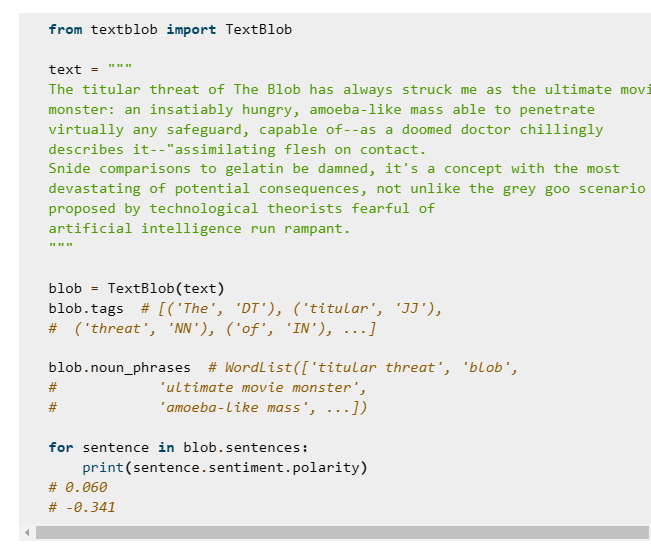
TextBlob is a Python library designed for handling textual data, providing an intuitive API to carry out various natural language processing functions such as part-of-speech tagging, sentiment analysis, noun phrase extraction, and classification tasks. Built on the foundations of NLTK and Pattern, it integrates seamlessly with both libraries. Notable features encompass tokenization (the division of text into words and sentences), frequency analysis of words and phrases, parsing capabilities, n-grams, and word inflection (both pluralization and singularization), alongside lemmatization, spelling correction, and integration with WordNet. TextBlob is compatible with Python versions 2.7 and higher, as well as 3.5 and above. The library is actively maintained on GitHub and is released under the MIT License. For users seeking guidance, thorough documentation is readily accessible, including a quick start guide and a variety of tutorials to facilitate the implementation of different NLP tasks. This rich resource equips developers with the tools necessary to enhance their text processing capabilities.
API Access
Has API
No
API Access
Has API
Yes


Integrations
Google Chrome
Yes
Microsoft Edge
Yes
NLTK
No
Python
No
YouTube
Yes
Integrations
Google Chrome
No
Microsoft Edge
No
NLTK
Yes
Python
Yes
YouTube
No
Pricing Details
Free
Free Trial
No
Free Version
Yes
Pricing Details
No price information available.
Free Trial
No
Free Version
No
Deployment
Web-Based
Yes
On-Premises
No
iPhone App
No
iPad App
No
Android App
No
Windows
No
Mac
No
Linux
No
Chromebook
No
Deployment
Web-Based
No
On-Premises
No
iPhone App
No
iPad App
No
Android App
No
Windows
Yes
Mac
Yes
Linux
Yes
Chromebook
No
Customer Support
Business Hours
No
Live Rep (24/7)
Yes
Online Support
Yes
Customer Support
Business Hours
No
Live Rep (24/7)
No
Online Support
Yes
Types of Training
Training Docs
Yes
Webinars
No
Live Training (Online)
No
In Person
No
Types of Training
Training Docs
Yes
Webinars
No
Live Training (Online)
No
In Person
No
Vendor Details
Company Name
Language Reactor
Country
United States
Website
www.languagereactor.com
Vendor Details
Company Name
TextBlob
Country
United States
Website
textblob.readthedocs.io/en/dev/
Product Features
Language Learning
Augmented Reality
No
Customization
No
Dashboard / Reporting
No
For Businesses
No
For Individuals
No
For Learning English Only
No
For Schools
No
Gamification
No
Immediate Grading
No
Offline Access
No
Personalized Learning
No
Progress Tracking
No
Speech Recognition
No
Tests / Quizzes
No
Virtual Reality
No
Product Features
Natural Language Processing
Co-Reference Resolution
No
In-Database Text Analytics
No
Named Entity Recognition
No
Natural Language Generation (NLG)
No
Open Source Integrations
No
Parsing
No
Part-of-Speech Tagging
No
Sentence Segmentation
No
Stemming/Lemmatization
No
Tokenization
No
