Incidents, accidents, and injuries at work are an unfortunate reality across most industries and business sectors. While we may have come to accept them as part of the working environment, there are still countless instances of these events that could have been prevented if only the company had taken a more deliberate approach to tracking and acting on a fundamental component of a safe workplace: near misses.
This brief article will introduce you to the basics of near misses, also known as close calls, narrow escapes, and behavior-based safety observations (BBSOs), and provide you with the information you need to put a near miss reporting system in place.
What is a Near Miss? (Definition with Examples)
Near misses in the workplace are those hazardous situations which do not produce any injuries or property damage and are therefore not considered accidents, even though one could have easily occurred.
You can think of them as any event that gives you and your company a chance to identify and control a hazard that you may not have known existed. That is why many H&S professionals are grateful for near misses. To them, they are “golden opportunities” for further safeguarding the work environment, as they provide insight into potential accidents and their root causes without anyone having to get hurt or costs running up.
There are countless types of near misses at work. Beyond clear instances of narrow escapes, any time an employee works in unsafe conditions or engages in an unsafe action, fails to comply with H&S regulations, or is subjected to a procedural failure, a near miss takes place… even if the employee is blissfully unaware of the fact.
Here are a few other near miss examples that are not so obvious:
- Working outdoors in wet or extreme weather (ex: heat wave or cold spell)
- Working with inadequate shielding on equipment with moving parts
- Using the wrong tools or equipment for a particular activity (ex: a stool or unstable object in place of a ladder)
- Walking into a forklift area when forklifts are not around
- Parking a vehicle too close to a hazard, such as a cliff or moving traffic
- Working too closely to sharp tools or other hazardous equipment in active use
Why Should You Log, Monitor, and Manage Near Miss Events?
Collecting data on near misses and behavior-based safety observations and then implementing corrective and preventive actions (CAPA) to prevent them is bound to take up your and your employees’ time (and therefore, the company’s money). Thankfully, near miss reporting comes with plenty of benefits and reasons to engage in it.
The first is the fact that near misses often presage the occurrence of an accident. According to 2015 data from the National Safety Council, roughly 75% of all accidents are preceded by one or more near misses, which makes sense intuitively, considering that the difference between a near miss and a serious injury can be a fraction of an inch or a split second of time.
Another reason is that, in several cases, near miss reporting comes with built-in ROI. When a near miss eventually leads to an accident, it is bound to cost the company dearly in lost work hours and worker’s compensation. Taking the time to investigate it and prevent it from recurring, despite the upfront cost, is often less expensive than ignoring it (and it can save lives!).
Most importantly, you should establish a behavior-based safety program because it has been proven to work.
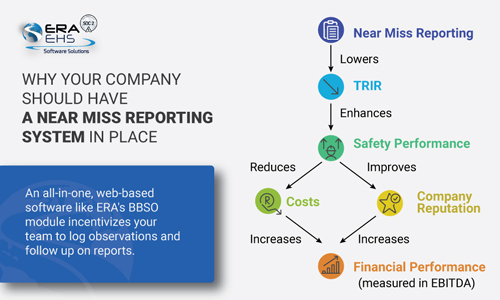
The Construction Industry Institute, for example, asserts in their (gated) “Using Near Miss Reporting to Enhance Safety Performance” presentation that near miss reporting lowers the OSHA Total Recordable Incident Rate (TRIR) and increases communication and trust about safety at the construction site.
But the benefits do not stop there. Research published in the Journal of Safety Science (Volume 172, April 2024) and based on 14 years of large panel data of European companies from all sectors indicates that better safety performance, obtained by fostering a safety culture and represented as the total injury rate, has a long-term positive impact on financial performance (measured in EBITDA). They concluded that the two are complementary objectives and that, as such, promoting safety should be seen as a strategic long-term investment.
To infographic below summarizes the chain of causality from near miss reporting to increased financial performance.
Which Data Should a Near Miss/BBSO Reporting System Collect?
ERA EHS Software believes a behavior-based safety program should provide the EHS professionals meant to follow up on a near miss with the Who, What, When, Where, Why, and How of a near miss event.
The When, Where, and Who are quite straightforward: the time and date of the near miss, the exact location where it took place (and ideally a photo), and the employee involved (as well as any other person affected, if applicable).
The What and How could be as simple as a blank text box where the employee can describe the incident in their own words. Here they may offer some form of incident categorization (slip, fall, hazardous spill, etc.) and a description of the activities that contributed to the near miss, such as the type of task the employee was involved in and the materials they were using at the time.
More in-depth reporting forms could also allow employees and/or managers receiving the forms to score the incident on one of several bases conveying urgency, such as the severity of the potential outcome (minor injury to fatality) or the frequency of occurrence (first-time versus repeating).
As for the Why, this is where the form (and the near miss reporting system as a whole) truly shines. By enabling employees to pinpoint the direct and indirect causes of a near miss (broken equipment, unsafe environment, unsafe behavior, careless management, etc.) themselves, EHS Managers and other supervisors give themselves the ability to discover hazards they might not even be aware of. Finding that gap in existing preventive measures is precisely the “golden opportunity” EHS professionals are after!
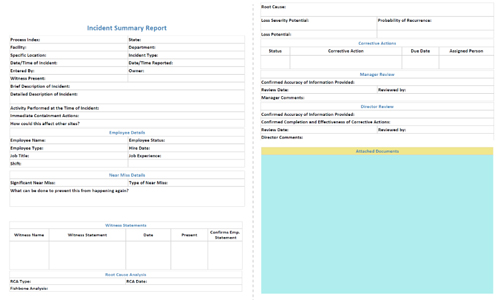
The image below shows what a (blank) near miss summary report generated by the ERA software looks like. Feel free to use it as a safety observation form template, but you should ensure your own form is tailored to your company’s specific needs and safety concerns.
Behavior-Based Safety Observation KPI Checklist
Beyond reviewing near miss forms and implementing CAPAs, EHS Managers should also gather and compile data on near misses at regular intervals, as this is the most effective way of monitoring and communicating the facility’s safety performance.
The following are some of the Key Performance Indicators (KPIs) your company should track for a thorough bird’s eye view of the state of near miss incidents at a facility:
- Number of near misses reported per shift and interval (weekly, monthly, and annually)
- Number of near misses per urgency score per interval
- Quality of reported near misses (ex: % of reported cases that did not pass validity check/were not “good catches”)
- Number of near miss investigations by status (pending, in progress, and concluded)
- Cycle time to complete each near miss investigation (i.e., number of days from report submission to CAPA implementation)
- Number of near misses according to whether work was stopped or not
As you can probably tell from looking at the list above, keeping up with near miss events at a medium- or large-scale facility is no easy task. That’s why many manufacturers are turning to BBSO software like ERA’s that offer smart forms, checklists, reports, KPIs, and benchmarks within an all-in-one web-based system.
How Do You Encourage Employees to Report Near Misses?
A near miss reporting program, however efficient it may be, is only as good as the employees’ willingness to make use of it. For that reason, EHS Managers should put in place behavior-based safety program policies that educate employees about the need for reporting and incentivize them to report.
The main takeaway here is that employees who fill out near miss forms should never be punished for doing so. Even when the employee is directly responsible for a near miss, disciplinary action only disincentivizes future reports. Instead, you should reassure employees that the focus is on preventing incidents, not assigning blame (or informing on others).
Another policy ERA recommends is to communicate actively with the employee who reported a near miss event at every step of the way: when the report is received, once it is reviewed and approved (as a valid near miss), when a CAPA has been chosen, and after the CAPA has been implemented. Doing so proves to employees that submitting a report can and does lead to tangible remedial action.
If you would like to go even further with your communication initiative, you could also compile a monthly summary of near-miss reports (anonymized to ensure privacy or potential repercussions from executives), a log of how they’ve been addressed, and the “lessons” the EHS team has learned as a result. Disseminate this report the way safety bulletins are commonly used in the industry.
Lastly, you should ensure whichever tool you choose for the job is as seamless and practical as possible, so as to avoid putting off employees from filling it out. This brings us to our next question…
Which Behavior-Based Safety/Near Miss Reporting System Should You Use?
Reporting systems for near misses in the workplace can be as simple as a paper reporting form employees fill out by hand. In 2026, however, this is far from the optimal choice.
A standardized desktop- and mobile-based software collects and processes relevant information in a centralized data pool accessible by all relevant stakeholders. Such a system guarantees active communication and complete audit trails without the risk of lost reports or missing details.
The BBSO module from ERA EHS Software empowers anyone with access to the system to log observations anywhere in the facility with the help of pre-defined checklists or dynamic data entry fields that cover all possible situations. ERA Scientists designed it to provide users with all the benefits of behavior-based safety programs mentioned in this article, including near miss scoring, validity checks, alerts to employees whenever the near miss event advances through the designated stages, and the automated creation and update of custom KPIs for a total safety performance overview.
Ready to optimize your near miss reporting system? Schedule a complimentary call with one of our Project Analysts today!
Related Categories